Richfield Votes
WE STRONGLY ENCOURAGE YOU TO VOTE EARLY STARTING FRIDAY OCTOBER 16
COUNTDOWN TO ELECTION DAY 2026
Richfield Votes is a grassroots effort to get out the vote in Richfield, MN. From first-time voters to seasoned voting veterans, we want Richfield residents to feel confident heading to the polls (or the mailbox!).If you experience or witness voter intimidation or anyone being refused the right to vote, gather as much information as possible and report it.ENGLISH: 866-OUR-VOTE 866-687-8683SPANISH: 888-VE-Y-VOTA 888-839-8682ASIAN LANGUAGES: 888-API-VOTE 888-274-8683ARABIC: 844-YALLA-US 844-925-5287
How do I register to vote?
Minnesota's voter registration process is one of the best in the country! You are eligible to vote if you are:-A U.S. citizen
-At least 18 years old on Election Day (16 & 17 year olds can pre-register)
-A resident of Minnesota for 20 days
-Not currently incarcerated for a felony conviction
-Not under a court order that revokes your right to voteAs of 2023, all eligible voters in MN are automatically registered to vote when they are issued a state ID.If necessary, you can register to vote or update your registration in advance on the Secretary of State website linked below or you can even register to vote at the polls at the time of voting.
How do I vote?
In Minnesota, there are three ways to vote:-Election Day Voting
-In Person Early Voting
-Mail-in Absentee VotingThere are no conditions to these options, so you can choose the method that works best for your lifestyle.If you are voting for the first time, be sure to check out the MN Secretary of State's page on first time voting, linked below.
Where do I vote?
Assuming you would like to vote in-person and not via mail-in ballot, you have two options:-Early Voting @ Richfield Municipal Center
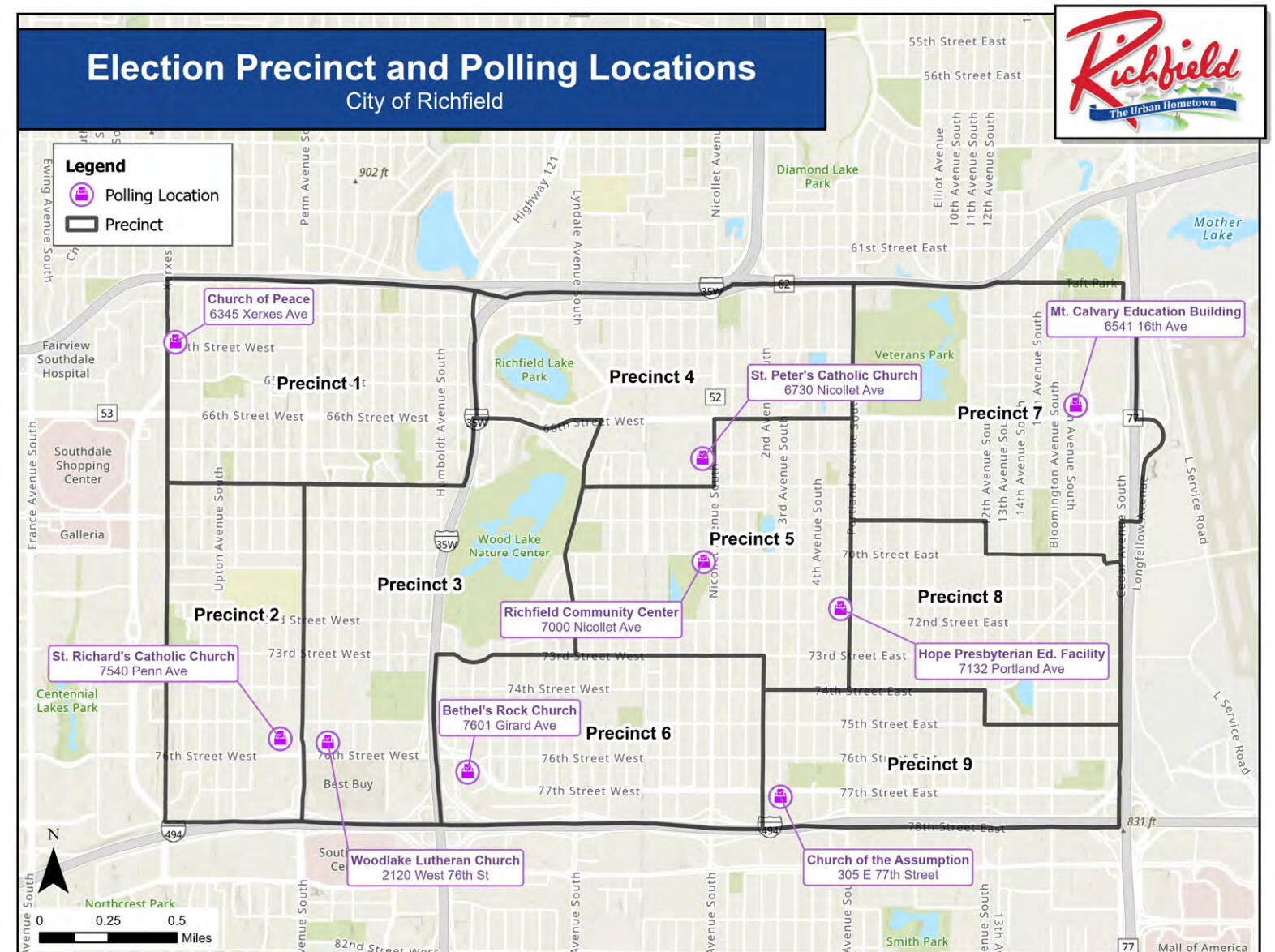
-Election Day Voting based on precinct location
Who is on the ballot?
There are a number of state, county, and municipal seats on the current ballot. Enter your address or zip code in the Secretary of State Voting Information Portal for a sample ballot.Knowing who is on the ballot is half the battle; knowing who you want to vote for is the next step. We're not here to direct you to any particular candidate, but we can help you gather information about them.To better help Richfield residents make their decision for City Council, we have asked both candidates--Sharon Christensen (incumbent) and Em Antin--a series of questions addressing the needs of Richfield citizens. Questionnaires were sent on 9/23/26, and as of 9/29 only Em Antin has replied. Responses are posted below.In addition to "who", there is also a "what" on the ballot. There is a MN constitutional amendment to provide more funds to public schools without raising income or property taxes. If the response to this amendment is left blank on a ballot, it will be considered a NO vote.
Voting FAQs
Click below for Minnesota's Office of the Secretary of State's list of common questions, tailored to Minnesota residents.
Voter Protections
Voting is a right, and no eligible voters should be intimidated or prevented from voting. It's easy to feel like these rights are being stripped away, but there are groups all over the country fighting to protect voting.If you experience or witness voter intimidation or anyone being refused the right to vote, gather as much information as possible and report it.ENGLISH: 866-OUR-VOTE 866-687-8683SPANISH: 888-VE-Y-VOTA 888-839-8682ASIAN LANGUAGES: 888-API-VOTE 888-274-8683ARABIC: 844-YALLA-US 844-925-5287
How else can I help?
You have a voting plan, but now you want to do more. Here are some great ways to help get out the vote:-Talk to friends, family, and neighbors about their voting plans
-Offer to give someone a ride or babysit their kids so they can get to the polls
-Volunteer to be an Election Judge
-Volunteer to be an Election Protection Ambassador or Post-Poll Close Monitors
-Door knock for candidates you support
-Donate to organizations dedicated to protecting voting rights
Em Antin for City Council Answers to Voter Questionnaire
Q: What inspired you to run for this office?A:I made the decision to run for office because of a desire I have always had to be a leader and serve the community I live in. This decision was made after talking with friends, fellow community members, and my family. All of whom thought I was the right person to lead, guide, and listen to our community for the next four years.Q: What experience do you have that qualifies you for this role?A:While experience is important listening to your community is fundamental as a city council person. My life experiences have taught me that. Experiences I have that will be key to helping guide and lead our city for the next four years include; being a treasurer to multiple different non-profits, being a Girl Scouts Troop Leader, being a advocate at local, state, and federal level on civil rights, disability rights, and LGBTQIA+ rights.Additionally, when I lived in Minneapolis, from 2005 - 2018, I served on both the Pedestrian Advisory Committee and the Nokomis-East Neighborhood Association where I focused on pedestrian issues and building bridges between different community members.Q: What is your favorite part about being a Richfield resident?A:My favorite thing about Richfield is how we feel like a small town in a big city. I know that my neighbors are there to help if I need it. Which is a great feeling to have.Q: What do you see as the biggest challenges facing our community right now? What specific policies or initiatives would you champion to address those challenges?A: I see our biggest challenge as building trust again in our community. Regardless of where we fell or felt about Operations Metro Surge it affected us and how we see our neighbors. We need to build bridges and connect with each other again. A big way I see City Council helping with this is creating listening sessions for neighbors to come together and build back some of that community we lost.Q: How would you work with those who don’t share your views to find common ground?A: Representative democracy is supposed to be about finding common ground to create the best solutions for us as a community. That is the frame of reference I come at any issue with, what do we have in common? Most of us want what’s best for our city and probably even want the same outcome we just see us getting there differently.
First and foremost I will talk with those that don’t share my view point to see if we at least want the same outcome in the end. The way we start to find common ground is by asking what is it we want to see in our community and going from there.Q: How would you make city government more accessible and responsive to constituents?A: The first thing is that we need clear communication on how to reach out to elected officials and city staff. I think for most people it’s not knowing where to start. Once that is established we can work on responsiveness to constituents. In general, I am a “never leave a email or voicemail unanswered” kind of person. So the question becomes how do we create a way for constituents to feel that they are being listened to? Automatic responses often feel hollow, I understand that. So we need to create opportunities for residents, city council, & city staff to meet together outside of city council or commission meetings.Q: What will you do to ensure underrepresented voices are heard?A: The biggest thing I can do is be that voice for them on city council and provide opportunities to speak. Making sure they know when issues that might affect them are going before the council or one of our commissions. Giving them time to organize and speak to city council on the issues and policies that will affect them.Q: How will you balance short-term needs with long-term planning?A: The biggest thing for me is the numbers. Is the short-term costs now going to benefit us long-term or is this a project better left to long-term planning because the cost is such that it is beneficial to spread it out over multiple years. The second biggest factor to me is will this short-term need benefit us in the long-term. Meaning if we do this now will we continue to see the benefit in 10, 15, even 20 years. If so, it is worth considering doing a it now because it will benefit the community for years to come.Q: Do you think our community is healthy and successful? If not, what would you do to change that?A: Yes we are healthy and successful. However, that doesn’t mean we can’t continue to improve. We have much about our city to be proud of. That does not mean though that we shouldn’t see what could be done to make it even better. Whether that is looking at housing, business development, or improving our parks.Q: What’s more important for our city right now: building new homes and commercial space or rehabbing/expanding/better utilizing our existing homes and storefronts?A: I don’t see this as an either or scenario. We need to be doing both. Where there are opportunities for new homes and commercial space we should be finding ways to have that happen. However, we should also prioritize rehabbing/expanding or utilizing current homes and storefronts first before new homes or commercial space is built. Both are beneficial to our community and serve different purposes.Q: How do you feel about the transportation options currently available in our city? Can all of our residents affordably and efficiently get where they need to go? If not, what will you do to improve transportation in our city?A: Mass transit in our city, especially by bus, needs to improve. It is very easy to go North & South on a bus but still difficult to go East & West. While we have made improvements and ride-share options have made it more possible it is still something that is lacking. This is something I will continue to advocate for to MetroTransit.Q: If you could change one thing in our zoning code, what would it be and why?A: I would change two things. First, the ability to built tiny homes (typically consider 250sq ft to 1000sq ft) in our city helping to provide more affordable housing options. Second, how far a house can sit from the street front.Q: How do you plan to involve residents in the decision making process in our city?A: I am always for creating opportunities for listening sessions. Whenever possible this should be the case, no matter the issue or the policy. Listening sessions are the best way for community engagement.Q: What are your views on the use of warrantless surveillance such as ALPRs by the city?A: I am against ALPRs or better known as FLOCK cameras for uses other than tracking license plates in active investigations. Our current contract with the FLOCK has been amended to address concerns around data privacy. However, these cameras have been shown to be misused in other cities. While I support tools that help law enforcement, FLOCK in the recent months has been shown to be problematic. Therefore I have come to the conclusion that they are not a good investment for the city to make at this time. However, I know contracts cities sign are easy to get into but can be hard to break. Therefore I am open to discussion on this topic with anyone. If issues around data privacy can be resolved, I would not be opposed to more discussions on their use. However, being that there are major concerns around data privacy, profiling, and cameras not being used as intended, I am against them. My thoughts on this topic continue to evolve as this was a new issue to me before starting my run for Richfield City Council At Large. As I continue to have conversations with residents, current elected officials, and law enforcement I am sure my views will continue to evolve and changeQ: If someone came to you with a proposal to build a new piece of public infrastructure in our city (road, bridge, etc.), how would you evaluate whether or not that project was worth implementing?A: First and foremost I would look into is these a city, county, state, or federal road or land. Once that is establish I would than work with the person or group purposing the public infrastructure to ensure it meet the needs of the community. If the proposal seemed to not meet the needs of the community it would be hard for me to support it and find it worth implementing.Q: What three steps would you take to put our city on a firmer financial footing?A: First, looking at are year or year budget planning. We should be looking not just at the next years but what does the spending now mean in 10 years.
Second, looking at proposed long-term budgeted projects and seeing if they are still a good investment for us now.
Third, weighing short-term balance budget over long-term city goals. Do we look unstable now because we are planning for a firmer stable footing in 5 years and have factored that into our long-term year over year budget.Q: If you received a $1 million grant to use for the city any way you wanted, what would you do with it and why?A: First and foremost I would not consider this my money if it is to be invested into the city. Therefore I would put together a focus group, then a listening group to evaluate the best use to spend this money on. Whether that be more accessible affordable housing, creating a homeowner tax credit, or investing into our park and recs system.